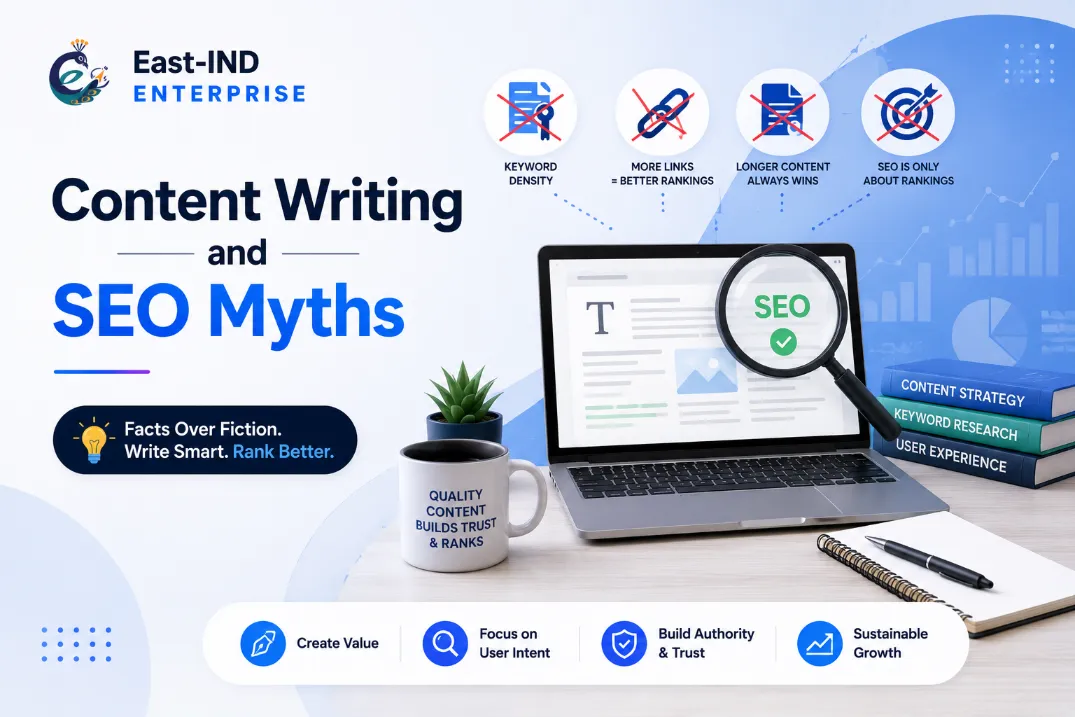
Content Writing and SEO Myths
Expert Byline
SEO Team
Release Date
August 26, 2026
If you have been in digital marketing for too long, you would definitely agree with us. This domain is completely filled with SEO myths. Mostly, these myths are so convincing that even an experienced professional would most definitely agree with these myths. But it is also very important to make sure we comply with standard SEO metrics.
Most common failures of content not ranking, social media not converting, or the failing backlinks—this most definitely means you are a victim of these myths as well. So, today, we want to be your myth busters and help you with all the myths of digital marketing.
Why should you break these myths?
Digital marketing misconceptions not only give you the wrong idea but also harm your brand's growth. So stop burning your budget for SEO myths from 2021 and 2022.
This blog is your guide to SEO myth-busting 101. Learn what's really true. We will cover common myths about content writing, myths about digital marketing, and social media marketing.
It's very important that you learn the difference between the myths and facts about digital marketing to build a strategy that really works. Now let's start with some common myths of content writing and marketing.
Table Of Contents:
The Great Myths About Content Writing
Without content, there is no internet. But without good content, there is no business. Many writers and business owners still follow the same old formats. But it is very important to consider all the historical algrothymic updates that google has made. If you do not comply with these updates, it is almost impossible for you to earn any traffic, forget monetizing.
operate under outdated or completely fabricated rules. Let's debunk the most toxic content writing myths.
Myth 1: Passing the "AI Detector Score" Guarantees High Quality and Rankings
This is perhaps the most modern and dangerous of the myths of content writing. With the explosion of generative AI, a cottage industry of "AI detectors" has popped up. Many writers believe that if they score "100% Human" on these tools, their content is automatically good, and Google will reward it.
The Reality:
AI detectors are notoriously inaccurate. Furthermore, Google has explicitly stated that they do not penalize AI-generated content if it is helpful, high-quality, and follows E-E-A-T (Experience, Expertise, Authoritativeness, and Trustworthiness) guidelines. Google ranks content based on value to the user, not the tool used to generate the first draft.
What You Should Actually Do:
Stop obsessing over arbitrary AI detector scores. Instead, focus on the "Information Gain" score. What unique perspective, original data, personal anecdote, or expert insight are you bringing to the table that an LLM (Large Language Model) couldn't possibly know? Edit your content for clarity, flow, and extreme relevance to the searcher's intent.
Myth 2: Content Writing is "Just Writing" Words on a Page
This is one of those myths about content writing that devalues the entire profession. Many business owners think they can just hand a topic to anyone who knows basic grammar and expect a high-performing blog post.
The Reality:
Effective content writing is a multidisciplinary skill. It is equal parts psychology, data analysis, SEO strategy, and copywriting. A successful content writer must understand search intent, structure HTML headings for crawlers, map the buyer's journey, and craft compelling hooks.
What You Should Actually Do:
Treat content creation as a strategic asset. Before a single word is written, there must be a brief that outlines the target keyword, the secondary LSI keywords, the target audience's pain points, the required internal links, and the specific Call to Action (CTA).
Myth 3: Longer Content Always Ranks Better
For years, the SEO community preached that you needed at least 2,000 words to rank on page one. This led to the "recipe blog phenomenon," where users have to scroll past 1,500 words of irrelevant backstory just to find out how long to bake a potato.
The Reality:
Word count is not a ranking factor. Search engines reward content that satisfies the user's query as efficiently as possible. If a user searches for "what is the capital of France," a one-word answer ("Paris") is infinitely better than a 3,000-word essay on French history.
What You Should Actually Do:
Let the search intent dictate the length. If you are writing an ultimate guide (like this one), it needs to be long and comprehensive. If you are answering a specific, narrow question, get straight to the point. Focus on depth of value, not volume of words.
Myth 4: You Have to Be a Subject Matter Expert to Write About It
This is a common fear among new writers. They believe they cannot write for a B2B SaaS company if they don't hold a degree in computer science.
The Reality:
While Subject Matter Experts (SMEs) are incredibly valuable, a skilled content writer is primarily an expert researcher and communicator. A good writer knows how to interview SMEs, synthesize complex information, and translate it into digestible content for the target audience.
What You Should Actually Do:
If you aren't the expert, borrow the expertise. Conduct interviews with internal team members, read industry whitepapers, and cite credible sources. Your job isn't to be the genius; your job is to make the genius accessible.
The Enduring SEO Myths and Facts
Search Engine Optimization is plagued by outdated advice. What worked in 2015 will likely get you penalized today. Let’s look at the 16 seo myths and facts (condensed into the most critical ones for today's landscape) to stop believing.
Myth 5: Keyword Stuffing Still Works (Or The "Perfect Keyword Density" Myth)
This is a classic seo myth that refuses to die. People still believe that if a keyword appears exactly 3.5% of the time, the page will magically rank #1.
The Reality:
Search engines use advanced Natural Language Processing (NLP). They understand context, synonyms, and related entities. Stuffing the exact exact-match keyword repeatedly makes the text unreadable and signals to Google that the content is spammy and low-quality.
What You Should Actually Do:
Focus on semantic richness. Use your primary keyword naturally in the Title tag, H1, URL, and introduction. Then, focus on related topics. If you are writing about "running shoes," naturally include terms like "arch support," "marathon training," "sole durability," and "pronation." Write for humans first; the algorithms will follow.
Myth 6: Any Backlink is a Good Backlink
When exploring link building myths, this is the most destructive. The belief is that whoever has the most backlinks wins, leading to people buying thousands of cheap, toxic links from Fiverr.
The Reality:
It is vastly better to have 10 links from highly authoritative, relevant websites in your specific niche than 1,000 links from random, spammy directories. Low-quality links can actually trigger manual actions or algorithmic downgrades (like the Penguin update).
What You Should Actually Do:
Focus on earning links, not buying them. Create "linkable assets" like original research, comprehensive data studies, or free tools. Conduct targeted outreach to relevant publications and offer genuine value, such as a guest post that solves a problem for their specific audience.
Myth 7: SEO is a One-Time "Set It and Forget It" Task
"We SEO'd the website last year, so we are good." This is one of the most fundamental myths in digital marketing.
The Reality:
SEO is an ongoing, competitive race. While you are resting, your competitors are publishing new content, earning new links, and improving their Core Web Vitals. Furthermore, Google updates its algorithm thousands of times a year. What is optimized today may be outdated tomorrow.
What You Should Actually Do:
Treat SEO as a continuous operational process. Schedule quarterly technical audits to fix broken links and crawl errors. Regularly review your existing content to update statistics, refresh outdated advice, and consolidate pages that are suffering from keyword cannibalization.
Myth 8: You Can Guarantee a #1 Ranking
If an agency promises you guaranteed #1 rankings on Google within a month, run away.
The Reality:
No one can guarantee rankings because no one controls Google's proprietary algorithm. Rankings fluctuate daily based on personalization, location, algorithm shifts, and competitor activity.
What You Should Actually Do:
Focus on guaranteeing inputs, not outputs. You can guarantee that you will produce three high-quality, intent-optimized articles per week. You can guarantee you will fix all technical errors. Set KPIs based on steady organic traffic growth and organic conversions, rather than obsessing over a single vanity ranking.
Dissecting the Myths of Social Media Marketing
Social media is fast-paced, highly visible, and incredibly misunderstood. Let’s tackle the myths of social media marketing, including the famous seven myths of social media marketing.
Myth 9: Social Media Marketing is Free
Because it costs nothing to create a Facebook or Instagram account, many businesses believe social media is a free marketing channel.
The Reality:
While the platform access is free, the reach is not. Organic reach on most major platforms has plummeted to near zero for business pages. Furthermore, the cost of creating high-quality assets (videos, graphics, copy) and the time required to manage communities are significant.
What You Should Actually Do:
Budget for social media just like any other channel. Allocate funds for content creation tools, scheduling software, and crucially, Paid Social boosting to ensure your best content actually gets seen by your target audience.
Myth 10: You Need to Be on Every Single Platform
The fear of missing out (FOMO) drives brands to create accounts on Facebook, X, Instagram, LinkedIn, TikTok, Pinterest, and whatever new platform launched yesterday, spreading themselves impossibly thin.
The Reality:
Your audience is not everywhere, and neither should you be. A mediocre presence on five platforms is far worse than a dominant, highly engaging presence on the one or two platforms where your ideal customers actually spend their time.
What You Should Actually Do:
Conduct audience research. If you are a B2B software company, go deep on LinkedIn and perhaps YouTube. If you are a visual lifestyle brand, dominate Instagram and TikTok. Pick your battles and own those specific channels.
Myth 11: More Followers Equals More Revenue
Vanity metrics are the bane of the online marketing myths landscape. Brands obsess over hitting 10k or 100k followers, assuming revenue will magically follow.
The Reality:
You cannot deposit followers in the bank. Having 50,000 disengaged followers or followers who will never buy your product is useless. An engaged audience of 1,000 true fans who frequently purchase and advocate for your brand is infinitely more valuable.
What You Should Actually Do:
Shift your KPIs. Stop tracking follower growth as your primary metric. Start tracking Engagement Rate (comments, shares, saves) and, more importantly, Click-Through Rate (CTR) to your website and the subsequent conversion rate from social traffic.
Myth 12: Negative Feedback Should Be Deleted Immediately
When a customer leaves a negative comment or a bad review, the knee-jerk reaction is to delete it to "protect the brand."
The Reality:
Consumers are smart. A page with only 5-star reviews and glowing comments looks fake and untrustworthy. Deleting negative comments often enrages the user further, causing them to take their complaints to other platforms where you have no control.
What You Should Actually Do:
Treat negative feedback as a public customer service opportunity. Respond promptly, politely, and transparently. Acknowledge the issue, apologize if necessary, and offer to resolve the problem offline (e.g., "Please DM us your order number so we can fix this immediately"). Handling criticism well often builds more trust than a positive review.
General Digital Marketing Misconceptions
Finally, let's look at the broader digital marketing myths and facts that impact overall business strategy.
Myth 13: Digital Marketing is Only for Big Businesses
Small, local businesses often believe they can't compete in the digital space against massive corporate budgets.
The Reality:
Digital marketing is the great equalizer. Local SEO (like optimizing a Google Business Profile) allows a small local plumber to appear above a massive national chain when a user searches "plumber near me." Hyper-targeted Facebook ads allow you to reach people within a 5-mile radius of your store for pennies on the dollar compared to a billboard.
What You Should Actually Do:
Claim and aggressively optimize your Google Business Profile. Collect local reviews. Use highly localized keywords on your website. Small businesses have the advantage of being nimble and authentically connected to their communities—leverage that.
Myth 14: Email Marketing is Dead
With the rise of Slack, WhatsApp, and social media DMs, the tech echo chamber frequently declares that "email is dead."
The Reality:
Email remains one of the highest ROI channels in digital marketing. It is the only channel where you actually own the audience list. Social media algorithms can change overnight, tanking your reach, but no one can take away your email subscriber list.
What You Should Actually Do:
Prioritize list building above almost all other top-of-funnel metrics. Offer high-value lead magnets (like ebooks, templates, or exclusive discounts) in exchange for email addresses. Then, nurture that list with consistent, valuable, non-spammy content to build a relationship before asking for the sale.
Myth 15: More Traffic Always Means More Sales
It seems logical: double the traffic, double the revenue. This leads marketers to chase massive, broad keywords just to get page views.
The Reality:
Traffic volume means nothing if the intent is wrong. If you sell enterprise accounting software ($5,000/month) and you write a viral blog post about "how to do your personal taxes for free," you might get 100,000 visitors, but zero sales. You attracted the wrong audience.
What You Should Actually Do:
Focus on Bottom-of-Funnel (BoFu) content first. Target high-intent, long-tail keywords (e.g., "best enterprise accounting software for manufacturing"). You might only get 100 visitors a month, but if 5 of them convert into high-paying clients, that traffic is vastly more valuable than a viral, irrelevant post.
Conclusion: Trading Myths for Metrics
The digital marketing landscape is complex enough without carrying the baggage of these outdated myths of digital marketing.
Success in content writing, SEO, and social media doesn't come from discovering a "secret hack" or tricking an algorithm. It comes from consistently delivering exceptional value to a clearly defined audience, measuring the results accurately, and iterating based on hard data rather than popular fiction. Stop believing the myths, start focusing on the facts, and watch your digital strategy finally generate the results you deserve.